-
-
-
-
BetterCredit App
![]() Effortlessly manage your loans
Effortlessly manage your loans![]() Easy access to customer service
Easy access to customer service![]() Make extra repayments & request statements and repayment date changes
Make extra repayments & request statements and repayment date changes
![Download the BetterCredit App on the Apple App Store]()
![Download the BetterCredit App on the Google Play Store]()
-
-
-
A bad credit loan is a term commonly used for a personal loan that may be available to someone with a lower credit score or negative information in their credit history. It isn't necessarily a separate type of loan. Whether you can get one depends on the lender's criteria and your financial situation, and approval isn't guaranteed.
Having a low credit score can make borrowing harder with some lenders, but your credit score isn’t necessarily the only information a lender will consider.
If you’re thinking about applying, it helps to understand how these loans work, what lenders look at and what to consider before taking on a new loan.
Bad credit loans at a glance
A bad credit loan is a term commonly used to describe a loan that may be suitable for someone with a lower credit score or negative information on their credit report. The loan itself typically works like any other personal loan. You borrow an agreed amount and repay it, plus interest and any applicable fees, through regular payments over a set period.
The main difference is often how the lender assesses applications and the range of credit histories they’re willing to consider. Having bad credit doesn’t automatically mean you will or won’t qualify. Every lender has its own eligibility and lending criteria.
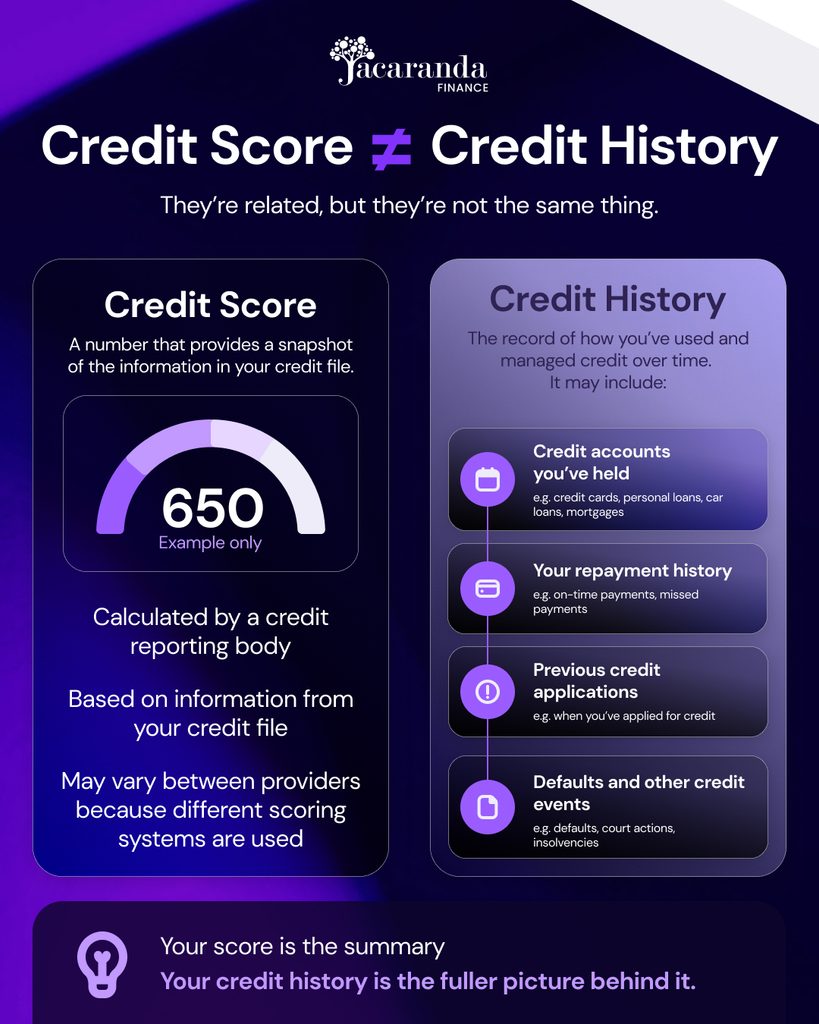
There’s no single credit score that officially means you have “bad credit” in Australia. Credit reporting bodies calculate credit scores using information from your credit report, and they don’t all use the same scoring system. This means a score considered low by one provider may be classified differently by another.
Your credit report may include information such as:
Your credit score gives lenders an indication of your credit history and how you’ve managed credit in the past. Generally, a lower score may make accessing credit more difficult with some lenders. However, some lenders will look at factors beyond your credit score and credit history when assessing an application. At Jacaranda Finance, your score won’t decide if you qualify to apply for a secured personal loan or car loan6.
You could get a personal loan with bad credit, but approval isn’t guaranteed.
Whether you qualify will depend on the lender, its lending criteria and your individual financial situation. Some lenders may place more weight on your credit score and credit history. They may disqualify your application immediately if it doesn’t meet their minimum threshold, regardless of your current financial situation.
Others may look at a wider range of information to understand your current circumstances. For example, at Jacaranda Finance, your credit score doesn’t determine whether you qualify for a secured personal loan or car loan6. Instead, we assess your current financial situation alongside your credit history.
It can be useful to understand a lender’s eligibility requirements before submitting a full application.
| Question | What to know |
|---|---|
| Is a bad credit loan a seperate type of loan? | Not necessarily. The term commonly describes loans available to people with lower credit scores or negative credit history. |
| Does bad credit automatically rule you out? | No. Elgibility depends on the lender's criteria and your financial circumstances. |
| Is your credit score the only thing lenders consider? | Not necessarily. Other financial information may also form part of an assessment. Criteria will vary between lenders. |
| Can applying affect your credit score? | A full application involving a hard credit enquiry may affect it. |
| Should you compare loans? | Compare rates, fees, repayments, term and total cost before deciding. |
When you apply for a loan, lenders need to assess whether you meet their requirements and whether you can afford the repayments.
Your credit history can be part of this process, but it doesn’t always tell the full story. For example, you may have experienced financial difficulties in the past that still appear on your credit report, even though your situation has since changed. On the other hand, having a good credit score doesn’t necessarily mean a new loan will comfortably fit into your budget.
At Jacaranda Finance, your credit score won’t rule you out6. We focus on your current financial situation and your credit history rather than using your numerical credit score to decide whether you may be eligible.
Our assessment considers information such as your current income, spending and ability to afford repayments, alongside your credit history.
Before applying for any loan, it’s important to understand what it will cost and whether the repayments will fit comfortably within your budget.
Here are some main things to consider:
1. Interest rate
Your interest rate helps determine how much you'll pay to borrow the money. Rates can vary between lenders and borrowers, so the rate you see advertised may not necessarily be the rate you're offered.
2. Fees
Check whether the loan includes establishment fees, ongoing fees, late-payment fees or other changes.
It's also worth looking at the comparison rate. This combines the interest rate with certain fees and charges to make it easier to compare the cost of different loans.
3. Repayments
Check how much you'll need to repay each week, fortnight or month and whether that amount comfortably fits your budget. A loan might help you pay for something now, but the repayments will become an ongoing expense until the loan is paid off.
4. Loan term
The loan term can mean smaller regular repayments, but you may pay more interest overall. A shorter term can mean larger repayments but potentially less interest over the life of the loan.
6. The lender
Take some time to understand the lender, its eligibility criteria and the terms of the loan.
Comparing your options can help you understand the differences in rates, fees, repayments and features before deciding what's suitable for you.
5. Secured or unsecured
A secured personal loan uses an asset as security for the loan, while an unsecured personal loan doesn't.
Secured loans may have different rates, terms or borrowing limits. However the asset used as security may be repossessed and sold if you don't meet your repayment obligation.
A formal loan application may affect your credit score if it involves a hard credit check.
A hard credit check is recorded on your credit report and can be seen by other lenders. Making several credit applications within a short period may also affect your credit profile.
A soft credit check is different. It doesn’t affect your credit score. Often lenders will use a soft credit check to see if you qualify or to give you a quote. At Jacaranda Finance, you can check if you qualify with no impact on your credit score*.
If you don't need to borrow immediately, it may be worth checking your credit report and taking some time to work on your credit history before applying.
There's no instant way to improve your credit score, but positive financial habits over time may help.
Some practical steps include:
In Australia, the main credit reporting agencies are Equifax and Experian. You can request a free copy of your credit report every three months. You can also monitor your credit score using resources such as ClearScore.
Monitoring your credit score and checking your credit report regularly can help you understand what’s being reported and identify any information that may need to be corrected.
They can be, depending on the lender and your circumstances. Lenders consider a range of factors when deciding the rate and terms they’re willing to offer, which could include your credit score.
A lower credit score could affect the rate, fees, loan amount or terms offered by some lenders. How credit information affects pricing and eligibility varies between lenders. That’s why it’s important to look beyond whether you can get a loan and consider what the loan will actually cost.
Some things to check when considering a bad credit loan include:
When you’re assessing lenders, the goal should be to find an option you can comfortably manage. Not simply one you’re eligible for.
A personal loan won't be the right choice for every situation.
Depending on what you need the money for, you may be able to consider alternative options such as using savings, delaying or reducing the cost of a purchase or speaking with a service provider about payment options.
Having a low credit score does not automatically disqualify you from being able to get a personal loan. Some lenders, such as Jacaranda Finance, don’t require a minimum credit score to apply. Whether you qualify depends on the lender’s eligibility criteria, how it assesses credit and your financial situation.
At Jacaranda Finance, your credit score doesn’t determine whether you qualify for a secured personal loan or car loan6. We assess your current financial situation and credit history, including your income, spending and ability to afford repayments.
If you’re considering a loan, you can check if you qualify with no impact on your credit score*.


 Effortlessly manage your loans

 Facebook
 LinkedIn
 Copy Link